
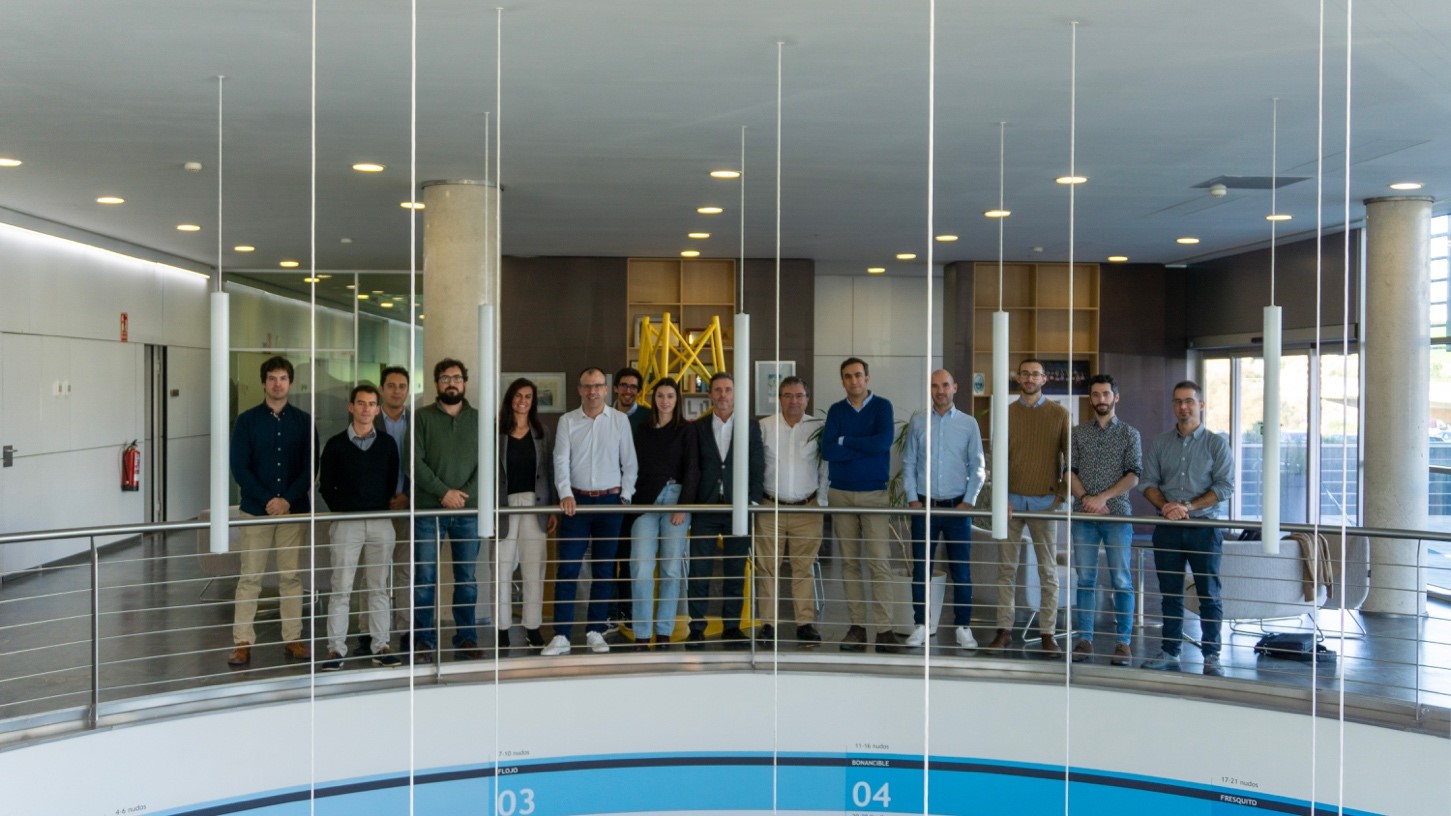
The main goal of the SEA-LIFT project is to develop a revolutionary system for installing and maintaining offshore wind farms, whose benefits include sustainability, lower costs and technological advances.
The European Green Deal outlines the EU’s long-term strategic vision to achieve a competitive, inclusive, and climate-neutral economy by 2050. In line with this plan, the EU Offshore Renewable Energy Strategy aims to increase the production capacity of this type of energy in Europe, from its current level (16 GW) to at least 60 GW by 2030 and 300 GW by 2050. Currently, according to Wind Europe, “ports are a crucial element in the supply chain of offshore wind farms, and one of the technological and logistical challenges they face is the need for low-cost means to develop the port operations required by the floating offshore wind sector".
In this context, the SEA-LIFT project aims to facilitate progress in the offshore wind market by eliminating the current need for large-tonnage, low-availability cranes, and reducing maritime transport by enabling in-situ maintenance operations at ports, thereby optimizing wind farm availability.
The SEA-LIFT research project is funded under the 2023 TRANSMISSIONS call by the Spanish Research Agency (AEI) and the Center for the Development of Industrial Technology (CDTI). The consortium, comprising five companies and two research centers, will build on NABRAWIND‘s Skylift technology for self-erecting towers (already in use for onshore wind farms) and adapt it for offshore wind applications. The consortium includes SAITEC and NAUTILUS, leaders in Spain’s floating wind-power sector, as well as INGECID and TETRACE, which bring expertise in product and process development for the marine sector. IHCantabria will provide simulation and validation of the technology in its test tanks, while CENER will develop the control techniques needed for tower self-erection on floating platforms.
By bringing all these elements together, the consortium aims to develop a new installation and maintenance system that will drive the offshore wind market by enabling the installation of high-capacity turbines (15 MW-20 MW) at greater depths, overcoming current technical and economic barriers. SEA-LIFT will allow the assembly of key wind turbine components on both fixed and floating offshore substructures. Its versatile design will enable installation both in ports and at sea. This flexibility represents a major innovation.
The SEA-LIFT project will enhance the availability of installation resources and offer greater flexibility in planning and executing new projects. Compared to traditional systems, the implementation costs of such solutions are expected to be significantly lower, as the consortium calculates it to be 3 to 5 times more cost-effective. Additionally, self-erection methods reduce dependence on specialized or high-load-bearing port infrastructure, opening up the market to ports that are currently uncompetitive due to infrastructure limitations.
SEA-LIFT project (PLEC2023-010279) funded by MICIU/AEI /10.13039/501100011033



/ Extensive experience across multiple sectors